
For investors

Real B2B commerceonchain.

Bringing companies, commercial relationships and trade activity onchain – for stablecoins, DeFi and programmable capital.

Request the deck → Read the thesis
Thesis

Onchain finance evolved in waves.

Each wave brought more of the financial system onchain. The next one brings the economy beneath it.

Wave 1

Crypto-native finance

BitcoinL1 blockchainsDeFi & protocols

Built the native financial stack.

Wave 2

Real-world financial assets

StablecoinsTokenized treasuriesTokenized equities

Brought traditional financial assets onchain.

Wave 3 · TRXVO

Real-world economy

CompaniesRelationshipsTrade eventsTrade history

Brings the economic activity beneath finance onchain.

The next step is to bring economic state onchain.

The missing layer

Economic primitives – the layer finance builds on.

TRXVO turns companies, relationships and trade events into persistent, portable and verifiable commercial state.

01Already onchain

Onchain financial layer

StablecoinsDeFiTokenized treasuriesTokenized equitiesCredit
02The missing layer · TRXVO

Economic primitives

Company IDRelationship IDCanonical trade eventsRelationship score
03What becomes possible

Programmable economy

Trade financeSettlementInsuranceWorking capitalAgentsNew investment products
→How primitives become shared commercial state
  1. Identifiable companiesCompanies keep ownership and control of their data.
  2. Identifiable relationshipsEvery buyer–seller relationship gets its own ID.
  3. Order → Delivery → Invoice → PaymentSigned, evidence-backed, independently attested where required, auditable.
  4. Relationship history + scoreCompleted trade builds a track record over time.
  5. Shared commercial statePersists across applications and platforms. Sensitive data stays offchain; the public blockchain anchors integrity.
Product

The network grows through two native mechanisms.

Growth is built into the protocol rules – not bolted on through marketing.

suppliersAnchorbuyers
01 · Anchor Status

A professionally attested company becomes a hub for suppliers, buyers and financing.

Criteria: scale · tenure · financial strength · stake.
Rule-based: maintained only while the conditions are met.
sellerbuyernew rails
02 · Joinable Rails

An existing relationship can be selectively opened to new participants – on the owner's terms.

Own identity: each join creates its own Rail ID, history and risk profile.
Ownership: the original Rail stays with the seller.

Anchors create density. Joinable Rails create propagation.

Where it sits

Consumer commerce became platform-native. B2B commerce becomes protocol-native.

Existing business systems feed real commerce into a shared protocol layer. Crypto applications, capital and settlement build on top.

Feeds in Existing business systems
ERP
CRM
EDI
Marketplaces
Procurement
TRXVO

Onchain Commerce Layer

Shared commercial statecompanies · relationships · commercial events
neutral across applications · owned by participants
Built on top Applications and capital
Stablecoins
DeFi
PayFi
Onchain credit
Trade finance
Agents
Vertical apps
Investment products

B2B commerce becomes part of the crypto stack.

Economics

Real commerce creates the economic layer of the protocol.

Verified commerce earns economic participation in the network. Protocol participation creates recurring demand for $TXVO.

01The $TXVO protocol economy
01

Verified commerce

Verified companies and completed Trade of Record. Allocation capped by attested revenue and EBITDA.

02

Earn $TXVO

Real commercial activity earns economic participation in the network.

03

Use $TXVO

Joinable Rail commitments, Anchor Status requirements, protocol deposits.

04

Protocol demand

Settled protocol activity requires market-acquired $TXVO.

Real commerce earns $TXVO. Protocol usage creates demand.

02Value accrues as commerce moves through the network
$TXVO token

Protocol economics

  • Protocol fees on settled commerce flow
  • Value locked in protocol commitments
TRXVO equity

Company economics

  • Transaction and success fees on commerce through TRXVO apps
  • Financing and value-added services
  • Reference applications

One commerce layer. Two value-accrual engines.

This section describes how the protocol mechanism is designed. It is not an offer of tokens and makes no statement about price, returns or value.

Market

The economic layer scales with global B2B commerce.

Global B2B commerce forms the commercial layer. Capital and financial services build around it.

01Commercial layerBusiness activity between companies. Creates the commercial state used across applications.
~$124T
Global B2B payment flowsAnnual payments between businesses
2028 forecast · Juniper Research
~$35T
International tradeGoods + commercial services, annual
2025 · WTO
02Financial layerCapital and financial services built around commercial activity.
$59.5T
Global corporate debtBonds + syndicated loans outstanding
Year-end 2025 · OECD
$2.5T
Trade finance gapUnmet demand for trade finance
2025 · Asian Development Bank

Commerce creates the economic state. Financial applications build on top.

Live today

Real B2B commerce already builds shared commercial state.

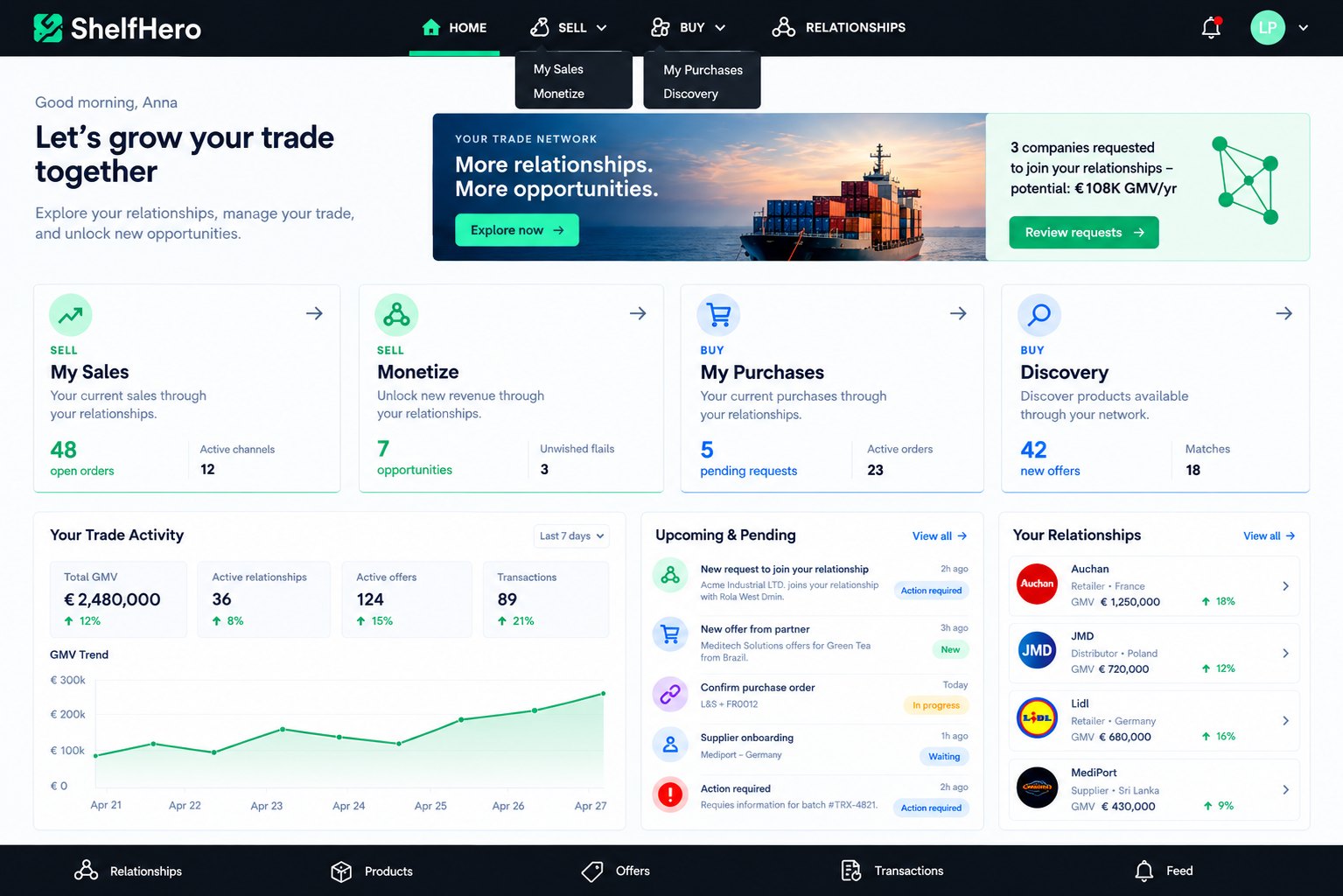
The protocol engine powers a reference application layer that handles B2B commerce end to end – on real trade.
01Protocol · TRXVO Protocol Engine
  • Identify companies
  • Identify relationships
  • Record canonical events
  • Build relationship history
  • Compute relationship score
02Application · reference layer
  • Create relationships
  • Set terms & publish offers
  • Place & manage orders
  • Track deliveries & payments
  • Open proven relationships
Order→Delivery→Invoice→Payment→Relationship history + score
app.shelfhero
ShelfHero dashboard – reference application built on TRXVO

ShelfHero – a reference application built on the TRXVO protocol.

Go-to-market

Container trade is the natural entry point.

Recurring relationships, durable trade history and proven distribution channels make container trade a natural environment for TRXVO. Live commerce corridor: Asia → Europe.

  1. 1Recurring container trade
  2. 2Relationship history grows
  3. 3Proven relationships gain value
  4. 4Proven relationships open to new suppliers
  5. 5New relationships create more trade

Goods in transit provide a collateral window

High-value goods remain identifiable while they move.

Commercial execution creates an evidence layer

Trade records can support enforcement and dispute resolution.

The network expands through existing relationships

Every proven relationship is a channel to the next participant.

Why now

The conditions for onchain commerce are converging.

Independent market signals are aligning around onchain money, capital markets and real B2B commerce.

SignalEvidenceWhy it matters for TRXVO
Stablecoins broke into B2B$226B B2B stablecoin payments in 2025, +733% YoYMcKinsey / Artemis, 2026Payments are onchain. Commercial context is not.
Onchain capital at scale$95B DeFi TVL · $306B stablecoinsDefiLlama, Sep 2026B2B commerce can expand the economic base of onchain capital markets.
Tokenized equities entered US market infrastructureSEC Innovation Exemption – conditional relief for tokenized NMS equitiesSep 17, 2026Company ownership can move onchain; commercial activity is still mostly offchain.
Trade finance demand remains unmet$2.5T gap; 80% of banks expect demand to growADB, 2025/26Better trade history and execution data have immediate economic value.

The financial stack is moving onchain. Commerce remains the open layer.

Investor relations

Where real trade goes, capital will follow.

Leave your email to request the deck and data room access.

[ Request received ]

Thanks – we'll be in touch with the deck shortly.

Or write to info@trxvo.com →